
The copy-paste strategy trap
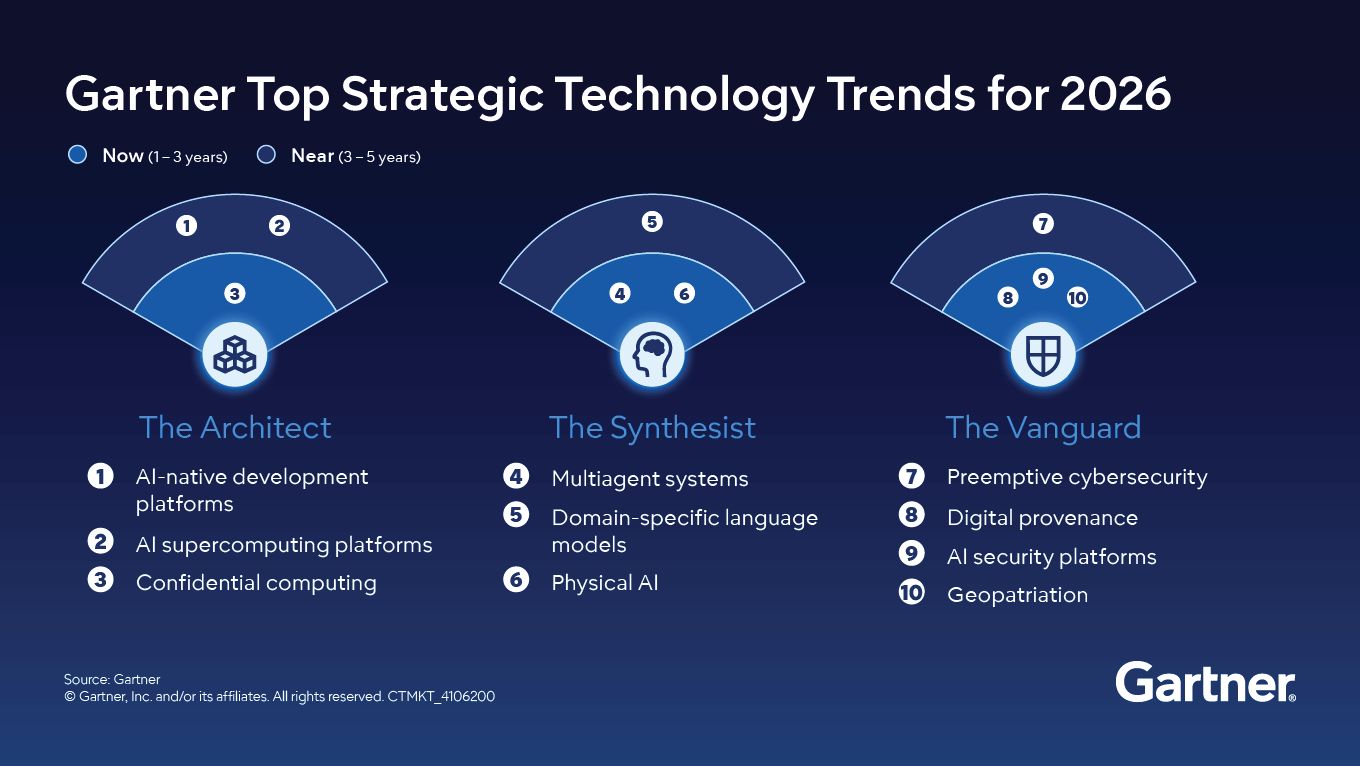
Every year, it's the same ritual. Gartner publishes its "Top Strategic Technology Trends." CIOs worldwide receive them like the Tablets of the Law. PowerPoint decks get updated. Roadmaps get adjusted. Budgets get realigned.
And every year, the same mistake is repeated: a strategy designed for American multinationals with 50,000 employees gets plastered onto European organizations of 500 people operating in a radically different regulatory environment.
Are Gartner's 2026 trends relevant? Yes, undeniably. Gartner thinks global, analyzes broadly, and identifies real underlying movements. But global relevance does not imply local applicability.
In Luxembourg, the competitive advantage doesn't hinge on the same levers as in San Francisco or Singapore. It hinges on efficiency, sovereignty, and security. And these three priorities radically transform how you should read the Gartner trends.
AI-Native Development Platforms: govern before you deploy
Gartner identifies platforms natively augmented by AI as a major trend. On this point, it's hard to disagree: the reality on the ground confirms it. Your teams are already using Copilot, ChatGPT, Claude, or Gemini to code, debug, and document. That's a fact. The question is no longer whether AI enters your development processes. It's already there. Often without your knowledge.
The European problem isn't adoption. It's the absence of governance.
Stop ignoring AI in your teams. Stop passively accepting it either. Three concrete actions to turn what's uncontrolled into something mastered:
Govern the usage. Which tools are authorized? What data can transit through cloud models? What security and confidentiality safeguards apply? If you don't have a clear policy, your developers are creating an implicit one, and it probably won't comply with NIS2 or GDPR.
Secure the pipeline. AI-generated code must undergo exactly the same controls as human code: code review, static analysis, security testing, architectural validation. Even more: it should be traced and identified as such for audits.
Reorganize into "tiny teams." AI amplifies individual productivity, which changes the optimal team-size equation. Teams of 3 to 5 people, augmented by AI, can triple the productivity of traditional teams of 10 to 15. But this requires technical and decision-making autonomy that most Luxembourg-based organizations don't yet grant.
AI Supercomputing: MeluXina, the sovereign trump card
Gartner predicts that by 2028, more than 40% of enterprises will have integrated hybrid high-performance computing architectures, up from 8% today. The trend is real, but the American reading is simple: rent GPU power from AWS, Azure, or Google Cloud.
For a European CIO, that reading is dangerous.
Your AI workloads, your simulations, your massive data analyses : all of this transits through infrastructure subject to the US Cloud Act. Every request, every model, every dataset passing through a US hyperscaler is theoretically accessible to American authorities. In a Luxembourg financial sector where confidentiality is a strategic asset, this is a risk that far too few executives quantify.
The good news: a sovereign alternative exists. MeluXina, Luxembourg's supercomputer operated by LuxProvide under the EuroHPC program, offers high-performance computing capacity for AI, analytics, and simulations, hosted on European territory, under European jurisdiction.
No need to buy thousands of GPUs. The hybrid approach, standard workloads on local infrastructure or trusted cloud, intensive computing peaks on MeluXina, lets you scale on demand without compromising data sovereignty.
This is the exact opposite of the "all-in US cloud" strategy that Gartner implicitly suggests. And yet it's the most rational strategy for a Luxembourg or European player.
Geopatriation: the urgency that's no longer up for debate
Gartner uses the term "geopatriation" to describe the trend of repatriating data to specific jurisdictions. For American analysts, it's an emerging trend, a regulatory curiosity.
For us, in Europe, it's been an operational emergency for at least five years.
The question is blunt: are your sensitive financial data still subject to the Cloud Act? If yes, you carry a legal and reputational risk that your board should register as a critical risk.
Repatriation to sovereign clouds or trusted infrastructure is no longer a project "to be studied." The European regulatory framework (GDPR, DORA, NIS2) leaves no room for interpretation. Fines are no longer theoretical : they run into tens of millions of euros and regulators have demonstrated their willingness to enforce them.
Three levels of action based on your exposure:
- Critical exposure (regulated financial data, health data): repatriation to sovereign or on-premise infrastructure. No compromise.
- High exposure (customer data, intellectual property): migration to a trusted European cloud with contractual and technical location guarantees.
- Standard exposure (non-sensitive data, non-critical workloads): public cloud remains acceptable, but with rigorous data classification governance to prevent the gradual drift toward "everything in the US cloud."
AI Security and Digital Provenance: compliance as a competitive advantage
NIS2 and the AI Act are coming. These aren't distant regulatory abstractions. They're texts imposing concrete obligations for traceability, auditability, and governance over AI systems deployed in the enterprise.
Gartner predicts billions in penalties by 2029. On this point, I agree with their projections. And I'll go further: organizations that transform compliance into a competitive advantage will take a decisive lead.
The logic is simple. In a market where all your competitors must comply with the same rules, those who do it early, properly, structurally, rather than in a rush with duct tape, will have a lower compliance cost and greater credibility with their clients and regulators.
Deploy AI governance now that includes:
- Model traceability. Which model produced which recommendation, based on which data, with what confidence level?
- Decision auditability. Every AI-assisted decision must be reconstructible. Not in theory. In practice, in front of an auditor.
- Data provenance. Where do your training data come from? Are they lawful? Are they biased? Are they up to date?
What Gartner doesn't tell you
The trends I've covered are those with direct relevance to the Luxembourg and European market. But Gartner also publishes trends (spatial computing, neuromorphic computing, energy-efficient computing) that fall more into visionary marketing than 18-month strategy.
My advice to Luxembourg CIOs: focus on what creates business value and reduces risk. Ignore the rest.
The most common trap isn't missing a trend. It's spreading your investments across too many fronts simultaneously, following a roadmap designed for a reality that isn't yours.
Innovation without strategy is waste. Innovation with vision and localized execution is your future.
Four questions to assess your positioning:
- Is your AI usage policy for development teams formalized and enforced?
- Are your intensive computing workloads hosted under European jurisdiction?
- Do you have a repatriation roadmap for your sensitive data currently in US cloud?
- Is your AI governance ready for a NIS2 audit?
If you answer "no" to more than one of these questions, the priority isn't to follow Gartner's 2026 trends. It's to build the foundations that will make those trends actionable.