
$1.024 trillion, and you control none of it
Behind every cloud request, every banking transaction, every video call, there's hardware. Chips. Drives. Cables. And behind that hardware, there's a global logistics chain of staggering complexity, whose cumulative value reaches $1.024 trillion in 2024, split between $627 billion for Compute, $155 billion for Storage, and $242 billion for Network.
That figure alone should appear in every board presentation. Because it reveals a truth that the rhetoric of "dematerialization" and "everything cloud" has carefully concealed: your digital transformation rests on physical infrastructure that you don't control, manufactured in factories you've never heard of, with materials extracted from mines you couldn't locate on a map.
I've spent recent months dissecting each of these three value chains. Here's the complete synthesis, from sand to datacenter.
Act I : Compute, $627 Billion in the Service of Power
The Compute chain is the most massive and the most publicized. It's the one that manufactures the CPUs, GPUs, and SoCs that power everything, from your laptop to AI clusters.
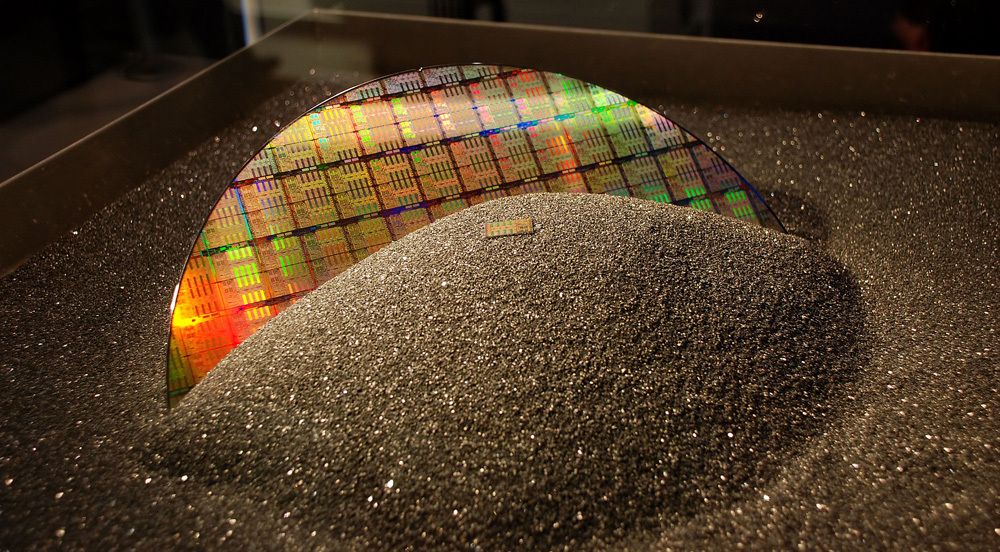
From sand to wafer: the art of ultra-pure silicon
It all starts with sand. But not just any sand. The silicon entering a semiconductor foundry must reach a purity above 99.9999%. This $21 billion market is dominated by two Japanese giants: Shin-Etsu (31%) and SUMCO (30%), supplemented by GlobalWafers (Taiwan), Siltronic (Germany), and SK Siltron (South Korea). Together, these five control more than 95% of global silicon wafer production.
The monocrystalline ingot is then sliced into 300mm diameter wafers. Each wafer can yield up to 1,000 chips. But to etch those chips, you need the most complex machines ever built by humanity.
The global bottleneck: ASML
The lithography equipment market is worth $109 billion. A single player reigns supreme: ASML, whose EUV machines represent 90% of the extreme ultraviolet lithography market. Each of these machines costs 200 million euros, weighs 180 tons, and requires three cargo planes for delivery. Applied Materials and Lam Research (United States) round out the ecosystem for deposition and etching.
This is the first major strategic point of vulnerability. If ASML can no longer deliver, for geopolitical, logistical, or technical reasons, global production of advanced chips stops. Not in six months. Immediately.
The foundries: Taiwanese dominance
The foundry market is worth $154 billion. TSMC (Taiwan) controls 67% of it. Samsung (South Korea) follows at 8.1%, then SMIC (China) at 5.5%, and GlobalFoundries (United States) at 4.6%. TSMC manufactures Apple chips, AMD Ryzen, and Nvidia H100, meaning the bulk of the planet's advanced processors.
The concentration is staggering: 20% of global semiconductor flows depend on an island of 36,000 km2 located 130 kilometers off the Chinese coast. Any escalation in the Taiwan Strait wouldn't just be a geopolitical crisis. It would be a global technological cardiac arrest.
From wafer to finished product
Assembly and testing ($50 billion) are dominated by ASE Group (Taiwan, 45%), Amkor (United States, 15%), and JCET (China, 12%). Each chip undergoes up to 1,000 hours of testing before validation.
At the top of the pyramid, finished products ($627 billion total, +19% in 2024) split between Intel and AMD for CPUs, and a near-monopoly by Nvidia at 90% of the AI GPU market. A single Nvidia H100 card at 30,000 euros consumes as much electricity as a house. The value creation along this chain is spectacular: +2,900% between raw materials and finished products.
Act II : Storage, $155 Billion of Memory Under Pressure
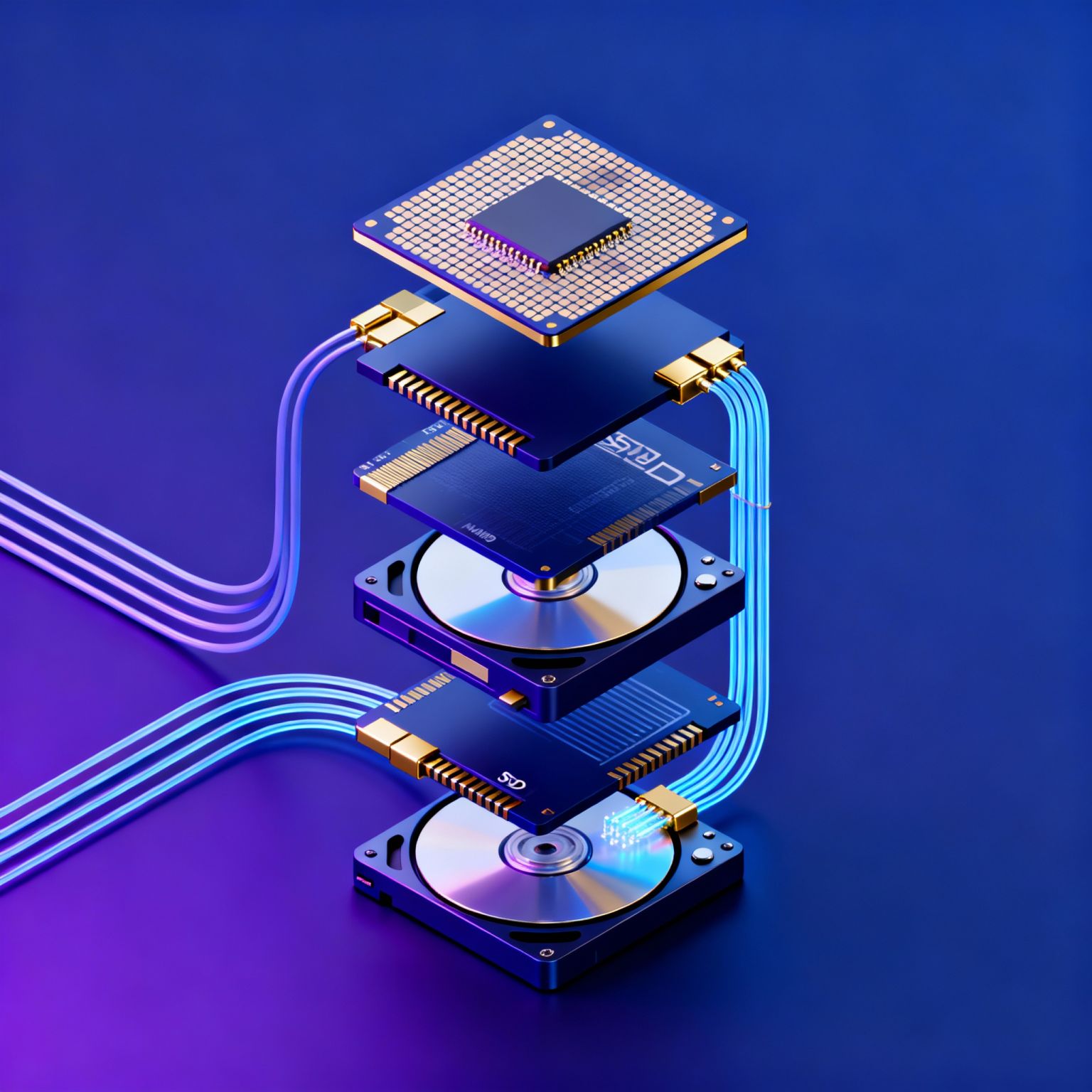
The Storage chain is less visible but equally critical. Every byte of data, your emails, your databases, your backups, depends on it.
NAND Flash: vertical stacking as an engineering feat
NAND flash memory fabrication shares its ultra-pure silicon foundations and ASML lithography machines with the Compute chain. But the technology diverges at the production level: here, the challenge is 3D vertical stacking, with 300mm wafers stacking 200+ layers of circuits. A NAND wafer requires more than 800 fabrication steps over 30 days.
The NAND market (approximately $65 billion) is a tight Asian oligopoly: Samsung (36.9%), SK Hynix (22.1%), Kioxia (13.8%), Micron (11.8%), and Western Digital (10.5%). Five players control more than 95% of production. And 75% of that production is located in Northeast Asia : South Korea, Japan, and Taiwan.
The hard drive duopoly
For mass storage and archival, hard drives remain indispensable. Nearline HDDs now exceed 20TB per drive and equip the cold storage tiers of every hyperscaler.
But the HDD market has undergone brutal consolidation: from 218 historical manufacturers, only three players remain : Western Digital (42%), Seagate (40%), and Toshiba (18%). And each hard drive contains 2-3% of its weight in NdFeB permanent magnets, made from Neodymium and Dysprosium, rare earth elements controlled at over 90% by China.
The hidden intelligence of controllers
SSD controllers ($31.82 billion) are the brain of each storage unit. Samsung, Phison (Taiwan), Silicon Motion (Taiwan), and Marvell (United States) control more than 70%. Each SSD undergoes over 1,000 hours of validation before shipment. The assembly and testing market adds another $39.21 billion.
Act III : Network, $242 Billion of Invisible Arteries

The Network chain is the one that connects everything. Without it, Compute and Storage are isolated islands.
From network ASICs to optical transceivers
As with Compute, the fabrication of network ASICs (specialized chips for switches and routers) goes through TSMC foundries and ASML machines. A 5nm network ASIC requires more than 600 fabrication steps over 25 days.
Optical transceivers ($14 billion in 2024) are the components that convert electrical signals into light for high-speed transmission. 400G/800G modules are the future standard for hyperscale interconnects. Production is concentrated in Taiwan, South Korea, and Japan.
American hegemony over active equipment
The switch and router market ($57 billion) is dominated by three American players: Cisco, Arista, and Juniper, which together control approximately 65% of the market. Huawei, despite its technological prowess, is de facto excluded from Western markets by geopolitical restrictions. Datacenter power distribution ($25 billion) is controlled by Vertiv, ABB (Switzerland), and Eaton (United States) at roughly 60%.
This segment reveals a specific vulnerability: more than 70% of active network equipment is under American control. For a European CIO, this means a regulatory dependency on US law that goes far beyond the Cloud Act.
Cables: the physical arteries of the digital economy
The datacenter cabling market is worth $21 billion. Fiber optics represents 60% of the market, driven by Corning (United States), Prysmian (Italy), and Nexans (France), the latter two offering notable European presence in an otherwise heavily American-Asian chain.
A hyperscale datacenter contains more than 10,000 kilometers of cables and requires more than 200 tons of copper. This copper dependency, whose main producers are Chile, Peru, and China, adds yet another layer of geopolitical risk on raw materials.
The Vulnerability Map: What These Three Chains Reveal Together
By overlaying the three value chains, a pattern emerges with alarming clarity.
Four single points of failure threaten the entire system:
- ASML (Netherlands): sole EUV lithography supplier, indispensable to all three chains.
- TSMC (Taiwan): dominant foundry for Compute chips and Network ASICs.
- The Samsung/SK Hynix duopoly (South Korea): nearly 60% of global NAND production.
- The Cisco/Arista/Juniper trio (United States): more than 65% of active network equipment.
Geographic concentration is extreme: Northeast Asia (Taiwan, South Korea, Japan) concentrates the majority of critical component production. The United States dominates design and finished equipment. Europe, despite ASML, Prysmian, and Nexans, remains marginal in the manufacturing chain.
Raw materials are the Achilles heel of the entire edifice: ultra-pure silicon in Japan, rare earth elements in China, copper in Chile and Peru. Every export restriction, every geopolitical tension, every natural disaster in these zones can trigger cascading effects across all three chains.
What This Means for European IT Strategy
For a European CIO, this analysis is not an academic exercise. It's a decision-making framework for concrete actions.
Diversify your suppliers with geopolitical awareness. Don't just negotiate the best prices. Evaluate the depth of each supplier's supply chain. A server assembled in Europe with 100% Taiwanese components protects you from nothing.
Integrate supply chain risk into your IT planning. Add safety margins on your hardware delivery timelines. Build strategic reserves of critical components. The "just-in-time" approach no longer works in a world where logistics chains are fragile.
Extend the lifecycle of your hardware. Every additional year of server use is a year during which you're not exposed to supply disruption risk. Prioritize modular, repairable, upgradeable hardware.
Support the European players in the chain. Prysmian, Nexans, Siltronic, ASML : Europe has industrial champions in certain links. Favoring them in your procurement isn't protectionism. It's risk management.
The global IT supply chain is a masterpiece of interdependence. But interdependence, when it becomes dependence, is a vulnerability. It's time for European CIOs to pop the hood and look at what's really underneath their cloud architectures. The answer might just change how they plan the next five years.