
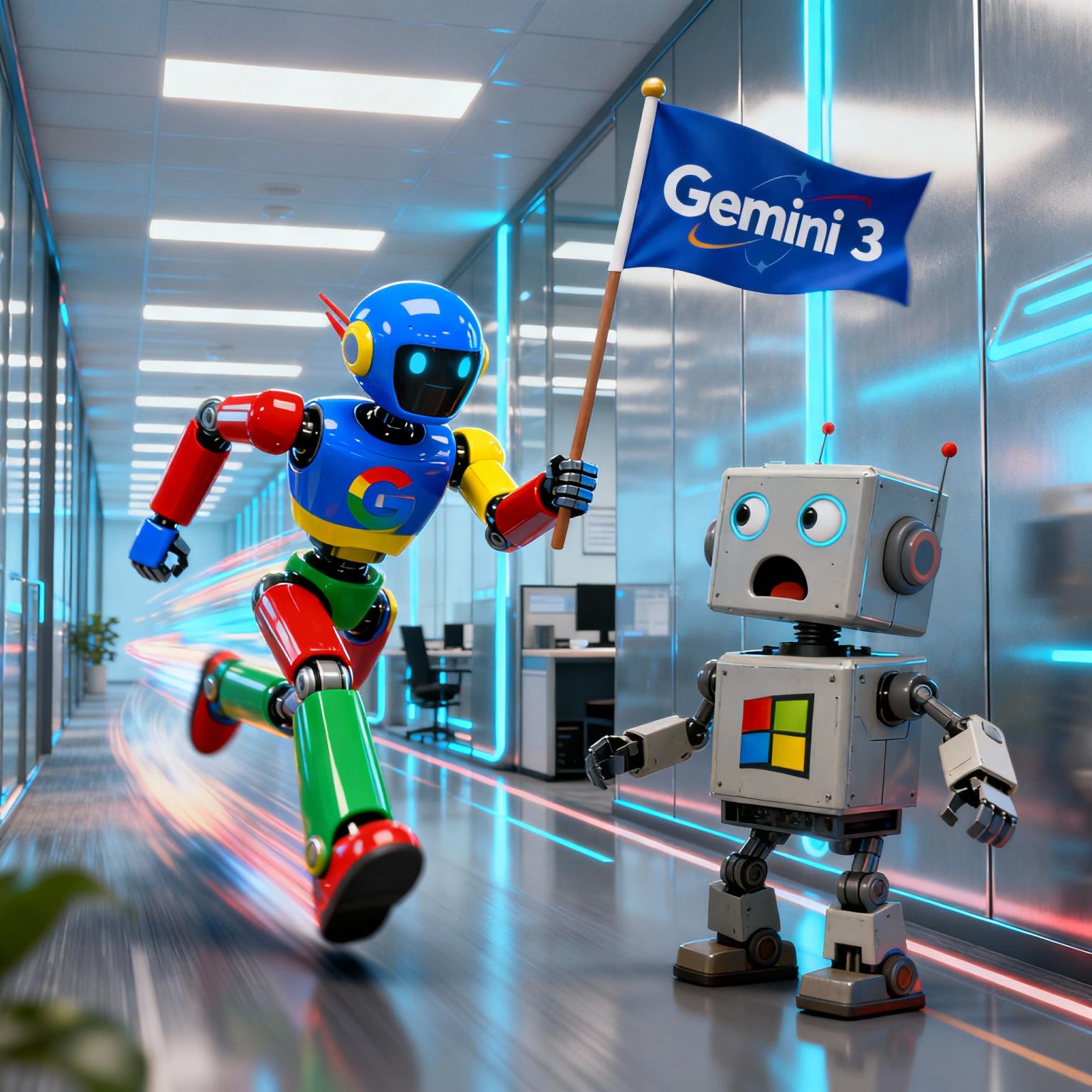
The day I had to admit I was wrong
Three years ago, I was convinced Microsoft had won the AI war before it even began. The 10 billion dollar investment in OpenAI, the lightning-fast integration of Copilot into the Office suite, the repositioning of Bing, the Azure overhaul around AI: it all seemed settled. Google, the historic search giant, looked like it was on the ropes.
I was wrong. And when I am wrong, I say so.
Google did not just close the gap. They just delivered a monumental slap to Redmond. And this slap is not a marketing stunt. It is a lesson in product execution that should give pause to every CIO managing a platform strategy.
From laggard to leader: anatomy of a comeback
The trap Microsoft fell into
To understand Google's comeback, you first need to understand Microsoft's strategic mistake. And that mistake has a name: asymmetric dependency.
Microsoft built its entire AI strategy on OpenAI. It was a brilliant bet in 2023. It has become a handicap in 2026. Microsoft does not control the engine of its own strategy. Every delay at OpenAI cascades onto Redmond's roadmap. And when OpenAI sells products directly in competition with Microsoft, the strategic tension becomes unsustainable.
Worse: Microsoft monetizes AI as a premium add-on. Copilot at 30 dollars per user per month. For a CIO managing 10,000 users, that represents 3.6 million additional dollars per year. That is precisely what makes it vulnerable.
Google's silent strategy
While the world was watching Copilot, Google was working in silence on three simultaneous fronts.
First front: the model. Google did not try to build the biggest LLM. It built the smartest. Gemini 3 Pro took the top spot on the LM Arena leaderboard with a historic 1501 Elo score, clearly surpassing the previous generation on PhD-level reasoning benchmarks, notably Humanity's Last Exam. This is not incremental progress. It is a qualitative leap.
Second front: distribution. This is where Google's strategic genius reveals itself. Rather than selling AI as an add-on, Google integrated it natively across its entire ecosystem: Search via AI Mode, the Gemini app, and above all Google Workspace. The most powerful Gemini agents are included directly in Business and Enterprise plans. No surcharge. No friction. AI is there, by default.
Third front: experience. The fluidity between Drive, Docs, Gmail, and Gemini agents makes the user experience profoundly different. You no longer "chat" with a bot in a separate window. You collaborate with a tool embedded in the daily workflow. The distinction between "working" and "using AI" disappears. That is exactly what users want, and it is exactly what Copilot has failed to deliver.
Gemini 3 under the hood: why it is a technical turning point
1501 Elo: what this score really means
The Elo score, borrowed from chess, measures the relative performance of models in blind comparative evaluations. 1501 Elo for Gemini 3 Pro places it clearly above everything OpenAI and Anthropic have produced to date. Unlike synthetic benchmarks that can be gamed, the LM Arena ranking is based on real-world use cases. It is the most credible benchmark in the industry.
Deep Think: the reasoning game changer
Gemini 3's Deep Think mode deserves particular attention. On the ARC-AGI benchmark, which specifically measures the ability to solve complex, novel problems, not simple token prediction, Gemini 3 delivers unprecedented performance.
Why does this matter for the enterprise? Real-world problems are not text completion exercises. They are multi-step reasoning challenges with contradictory constraints and real financial consequences. A model that excels in deep reasoning can assist a financial analyst in due diligence or a lawyer in analyzing complex contractual clauses.
The cost-performance ratio that kills
And then there is the number that hurts the competition. For a 1-million-token output task:
- Gemini 3 Pro: approximately 12 dollars.
- GPT-5.2 Pro: over 160 dollars.
A factor of 10 or more. For a CTO running inference pipelines in production, this is not a detail. It is the difference between a viable project and a financial sinkhole. Enterprise AI is not a benchmarking exercise. It is a cost-per-unit-of-value exercise. And on this playing field, Google crushes the competition.
The "Agentic First" approach: the real game changer
Beyond benchmarks, Google's true strategic breakthrough has a name: Agentic First.
From assistant to virtual colleague
Gemini 3 does not just generate text or code. It acts as a genuine autonomous agent capable of interfacing with internal enterprise systems, chaining complex actions, and adapting to context without constant human intervention.
A Gemini agent can access your documents in Drive, cross-reference information across multiple sources, execute workflows, and report on its actions. This is no longer a chatbot. It is a digital collaborator that understands your organization's context.
For CIOs, the question is no longer "which is the best model." It is: which platform offers the least friction for my teams? And the answer, for the first time in three years, is no longer automatically "Microsoft."
What this means for your stack
If you are "full Microsoft" out of habit, here are the questions you should be asking your team this week:
Total cost of ownership. How much are you actually paying for Copilot, per user, per month? What is the actual adoption rate (not the number of assigned licenses, the number of daily active users)? What measurable ROI have you generated in 12 months?
Usage friction. Do your users have to leave their workflow to "use AI," or is AI natively integrated into their daily tools? Every extra click, every context switch, every modal window reduces adoption.
Strategic dependency. What is your exposure to OpenAI-Microsoft risk? If OpenAI changes its strategy, pricing, or licensing model, what is the impact on your roadmap? Do you have a credible alternative?
The strategic lesson for European decision-makers
Potential vs usage
Microsoft had the potential. Google has the usage. This distinction is crucial for understanding what is at stake.
Usage means integration into the daily lives of millions of users, measurable value creation. The history of technology shows that usage always wins. Betamax was better than VHS. Concorde was faster than the Boeing 747. Technical potential is never enough.
Implications for European CIOs
For European decision-makers, this reshuffling arrives at a strategic moment. The AI Act is coming into force, the question of data sovereignty is more pressing than ever, and dependency on American platforms is a risk identified by every executive committee.
Competition between Google and Microsoft is, paradoxically, good news for Europe. It creates negotiating leverage, forces stronger guarantees on data localization, and opens a window for European players building sovereign alternatives.
The worst choice a CIO can make today is to remain locked into a single ecosystem out of inertia. The second worst choice is to switch ecosystems because of a trend. The right choice is to evaluate coldly, with data, which platform produces the most value for your specific context.
The cards have been reshuffled, and that is an opportunity
Three years ago, the question was "how do we catch up with Microsoft on AI?" Today, the question is "which platform generates the most value with the least friction?" And the answer is no longer as obvious as it once was.
Google played the comeback with remarkable strategic discipline: a technically superior model, frictionless native distribution, an accessible economic model, and an "Agentic First" vision that redefines what an AI assistant can do in the enterprise.
For CIOs, it is an invitation to question assumptions. To audit your actual costs, measure your actual adoption rates, and evaluate whether your platform strategy serves your business objectives or your organizational comfort.
The AI platform war is not over. It has just truly begun.