
The question that kills your RAG
Ask your current RAG system this question: "What is the impact of security policy X update on service Y?"
Watch the response. In 80% of cases, your system will return two documents: the security policy PDF and the service documentation. Perhaps even with a flattering similarity score. But it will not give you the answer. Because it does not understand the actual chain of dependencies linking the policy to the service. It does not know that policy X impacts component A, which is consumed by middleware B, which feeds service Y via an internal API.
Your Vector DB does not reason. It guesses. And in an enterprise context where decisions carry millions of euros in consequences, the difference between guessing and reasoning is the difference between an impressive POC and a reliable production system.
80% of RAG POCs plateau. Here is why, and how to break through.
Vector search is blind to structure
You were sold RAG as the Holy Grail for making your enterprise data talk. The promise was seductive: take your documents, transform them into vectors, store them in a vector database, and ask your questions in natural language. The AI will do the rest.
The problem is that this promise rests on a fundamentally flawed assumption: that semantic proximity is enough to capture enterprise knowledge.
The glorified bag of words
A vector database calculates distances in a multidimensional space. It retrieves what "resembles" your query. It is a glorified "bag of words", more sophisticated than a classic search engine, but structurally limited.
It captures thematic similarity, fuzzy search, and broad recall well. But it captures neither dependencies (A depends on B which depends on C), nor causality (if A changes, B is impacted), nor hierarchy (A belongs to domain C), nor conditional business rules.
The 80% ceiling
It is this structural limitation that explains why 80% of RAG POCs plateau. The initial results are impressive : the AI correctly answers simple questions, the "where do I find information X?" type. But as soon as questions become relational, conditional, or causal, the system collapses.
Teams try to work around the problem by adding context to prompts, slicing documents more finely, tweaking chunking and retrieval parameters. These optimizations produce marginal gains. Because the problem is not in the tuning. It is in the architecture.
GraphRAG changes the game
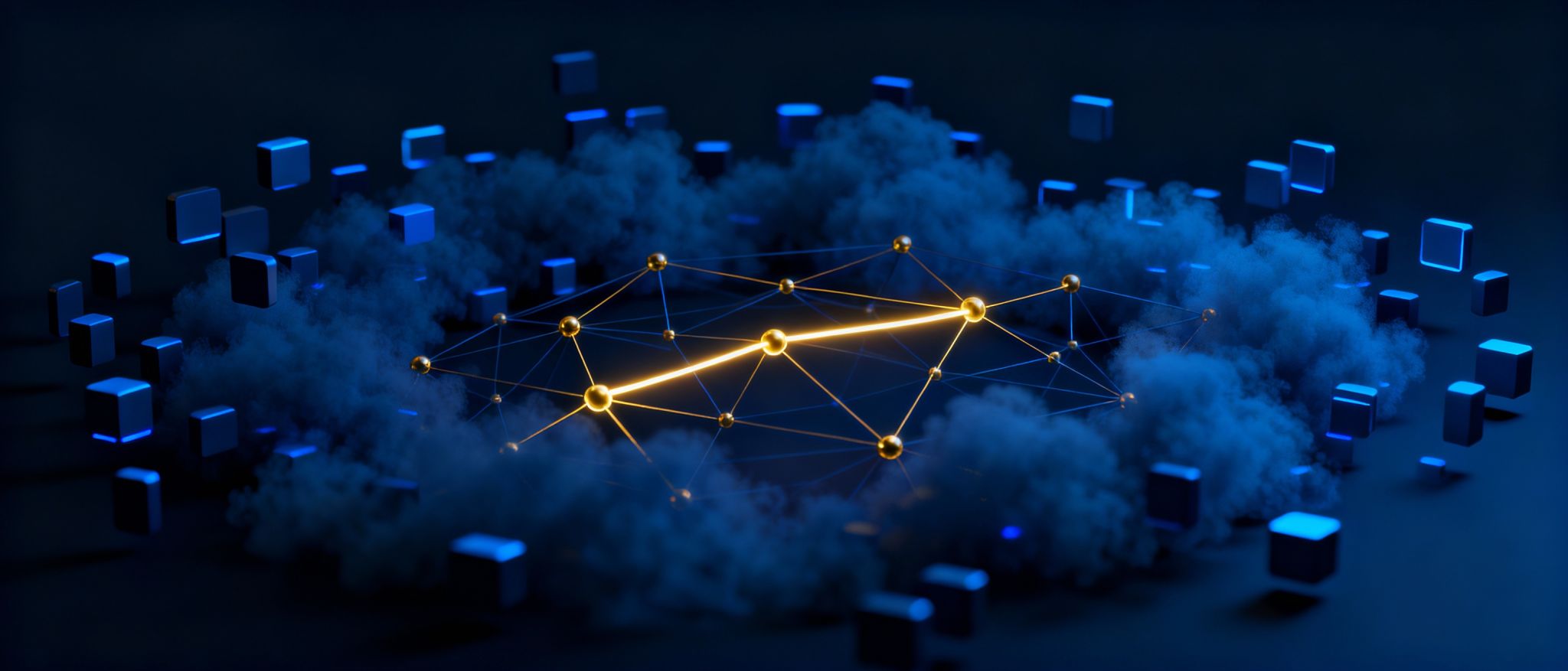
GraphRAG does not search for "chunks of text that resemble your question." It navigates a knowledge graph: a structured network of nodes (components, services, rules, people, processes) and relationships (depends on, impacts, governs, belongs to).
Reasoning through navigation
When you ask the question about the impact of security policy X on service Y, a GraphRAG system does something fundamentally different from a vector search. It follows a path in the graph:
- It identifies the node "Security Policy X."
- It traverses the "governs" relationship to the affected components.
- It follows the "is consumed by" relationship to dependent services.
- It reaches the node "Service Y" and reconstructs the complete impact chain.
The answer is never written as-is in a document. It is inferred from the graph structure. This is the difference between searching for an answer and constructing one.
The power of typed relationships
In a knowledge graph, every relationship carries a type and attributes. "A depends on B" is not the same as "A is an alternative to B." "A impacts B with high severity" is not the same as "A impacts B with low severity."
This relational richness enables queries that vector search simply cannot express:
- "What are all the services impacted if component X goes down?" (impact analysis)
- "What is the critical path between the customer and the payment service?" (risk analysis)
- "What compliance rules apply to this data flow?" (regulatory audit)
Governance, NIS-2, ISO 27001: traceability as a strategic differentiator
This is where GraphRAG moves from a technical improvement to a strategic advantage.
The black box problem
A classic RAG system based on vector search is a black box. When it produces a response, you do not really know why. You can see the document chunks that were retrieved, but the reasoning that led to the response remains opaque. For informal internal use, that is acceptable. For an auditor, it is a problem.
The graph exposes the reasoning
A GraphRAG system, by construction, exposes the reasoning path: which entities were traversed, which relationships were followed, which rules were applied. The auditor does not see "the AI said that..."; they see "here is the evidence, traceable and explained, step by step."
In the context of NIS-2 (European cybersecurity directive), ISO 27001 (information security), and GDPR, this traceability is the difference between an AI system you can defend before a regulator and an AI system that exposes you to sanctions.
Compliance is not a barrier to AI adoption. It is an architecture criterion.
The winning architecture: the hybrid approach
The good news: you do not need to throw out your vectors. Vector databases remain excellent at what they do well : fast, full-text, fuzzy search. The robust architecture in 2026 is hybrid.
Layer 1: Vector Store for semantic similarity
Your vector database (Qdrant, pgvector, Weaviate) remains the entry point for document search: content discovery, semantic matching, broad recall.
Layer 2: Knowledge Graph for structure and causality
A knowledge graph (Neo4j, Apache AGE) captures the structure of your organization: components, services, rules, dependencies, flows, responsibilities. This graph is not auto-generated. It is built and maintained as a strategic asset ; every node and every relationship represents validated, versioned knowledge.
Layer 3: Intelligent orchestration
The critical component is the orchestrator that decides, for each question, which retrieval strategy to use:
- Factual question ("Where do I find procedure X?"): classic vector retrieval.
- Relational question ("What is the impact if we decommission service Y?"): graph traversal.
- Hybrid question ("What documents mention risks related to component Z and its dependencies?"): combined vector + graph.
Reference architecture diagram
[User] --> [API Gateway]
                  |
            [RAG Orchestrator]
               /          \
[Vector Store]              [Knowledge Graph]
(fuzzy search)              (structure, causality)
               \          /
            [Enriched Context]
                  |
               [LLM]
                  |
          [Traceable Response]
Technology choices for European sovereignty
For organizations subject to NIS-2 or handling sensitive data, every component can be deployed in a sovereign manner:
- Vector Store: pgvector (PostgreSQL extension) or Qdrant (open source).
- Knowledge Graph: Apache AGE (PostgreSQL extension) or Neo4j Community Edition.
- LLM: Mistral or LLaMA, deployable on European infrastructure.
No dependency on an American hyperscaler is necessary. This is a deliberate choice that aligns technical strategy with regulatory constraints.
From theory to implementation
The build does not happen in a single sprint. A realistic roadmap:
- Phase 1 (months 1-2): Knowledge Graph core on a limited scope. Model validation with domain experts.
- Phase 2 (months 2-3): Hybrid architecture deployed. Quality measurement against vector-only baseline.
- Phase 3 (months 3-6): Graph expansion, industrialization of data ingestion, governance (who creates nodes, who validates relationships, what update cycle).
Your AI projects: are they guessing, or are they reasoning?
The distinction is fundamental. A system that guesses, that retrieves similar documents and lets the LLM improvise a synthesis, is a fragile, opaque, and barely auditable system. A system that reasons, that follows structured paths in a knowledge graph and produces traceable responses, is a system you can put into production, defend before an auditor, and evolve with confidence.
You cannot automate a business you do not structurally understand. Vector-only RAG is an attempt to bypass this truth. GraphRAG is a way to embrace it.
The question is no longer whether GraphRAG is the future of enterprise RAG. The question is how many vector POCs you are going to let plateau before you change your approach.