
The sentence that froze the room
Luxexpo, Luxembourg. The room is packed. Entrepreneurs, investors, corporates : the Luxembourg tech ecosystem has shown up in force for the LU Venture Days. On stage, Jillian Manus, a towering figure of Silicon Valley, delivers her masterclass "Silicon Valley vs EU: Reality - Tactics - Strategy."
And one sentence sums it all up:
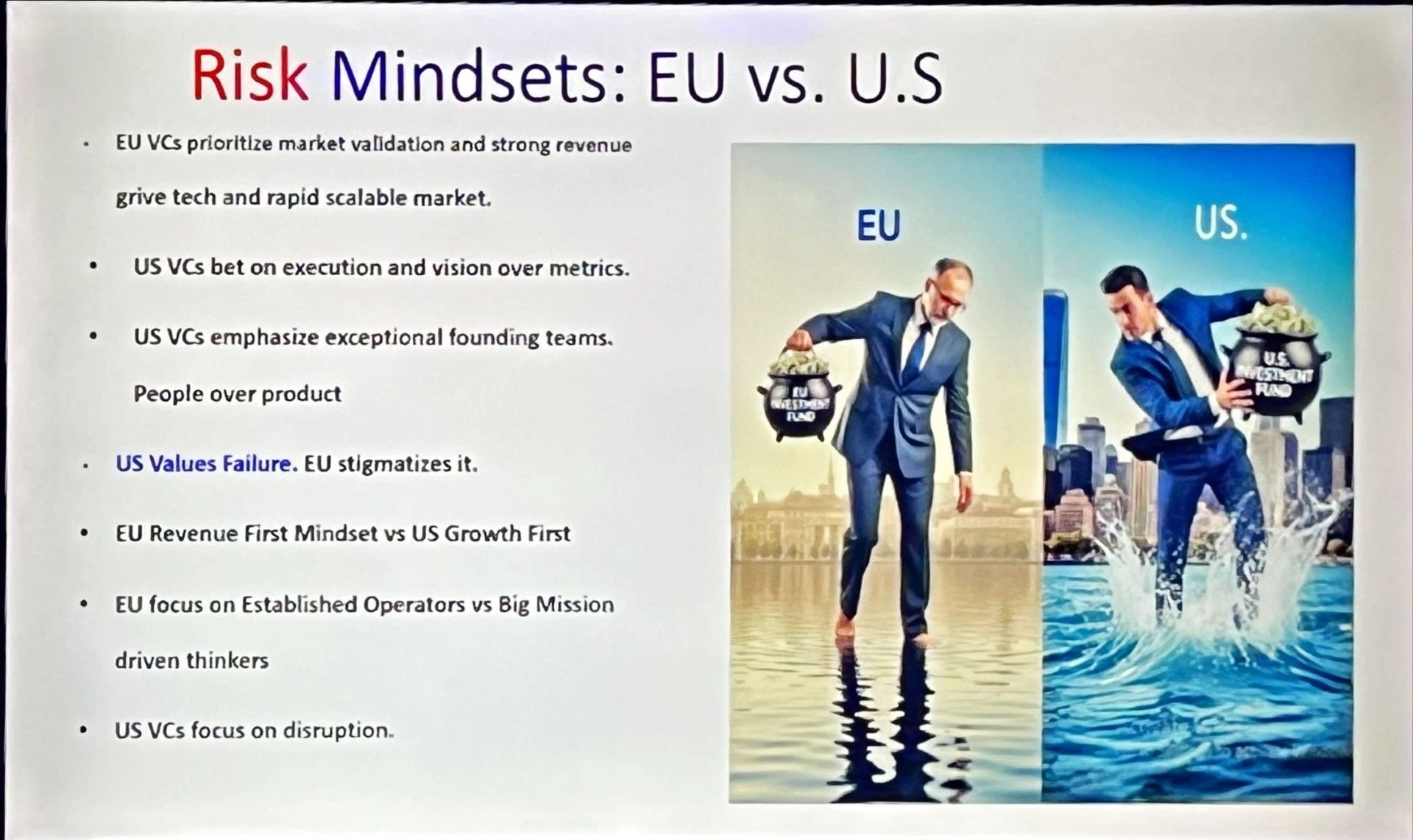
"In Europe, they say: show me your revenue. In the US, they say: show me your vision."
This asymmetry is not just a cultural anecdote. It is the central mechanism that explains why Europe produces extraordinary talent, identifies real problems, builds viable solutions, and yet fails to produce technology champions at a global scale.
The LU Venture Days confirmed it in the most direct way possible. And this observation deserves an unflinching analysis.
Reverse Pitches: proof from the field
One of the most revealing formats at the event was the "Reverse Pitches": instead of letting startups pitch to investors, corporates present their operational problems. Participants listen. The market speaks.
The result was striking. Three separate companies described, in precise terms, exactly the same type of problem : operational inefficiencies that existing software solutions, developed by European startups, already solve.
The demand exists. The supply exists. The funding to connect the two? Insufficient.
This is not a market problem. It is a problem of financial courage. Luxembourg and European corporates identify real needs. Local startups develop technically solid responses. But the funding mechanism that should accelerate this connection, early-stage venture capital, operates with a fundamentally different philosophy from the one that propelled Silicon Valley.
The anatomy of the gap: Europe vs the United States
The numbers are brutal. In 2025, the United States invested over 180 billion dollars in venture capital. Europe, with a comparable population and a similar aggregate GDP, invested around 52 billion. A 3.5-to-1 ratio. And this ratio worsens in the most critical phases.
The seed gap: the problem starts in the cradle
The first funding round, the seed, is where everything is decided. It is the moment when a team with a vision and a prototype must secure the means to validate its market, recruit its first engineers, and prove its model.
In the United States, a typical seed round falls between 2 and 5 million dollars. Investors evaluate the team, the vision, and the addressable market. Revenue? Optional. Traction? One signal among others.
In Europe, and particularly in Luxembourg and neighboring markets, a typical seed round hovers between 300,000 and 1.5 million euros. Investors demand proof of revenue, retention metrics, sometimes even early profitability. They ask a baby to run a marathon before teaching it to walk.
The result is predictable. European startups survive instead of growing. They optimize for frugality instead of attacking the market. They focus on immediate revenue instead of building the technology infrastructure that would enable hypergrowth.
The culture of risk: the philosophical fracture
Jillian Manus was crystal clear on this point: Silicon Valley does not fund business plans. It funds convictions. The team's track record. The market size. The audacity of the vision. American VCs know they will lose money on eight startups to make a hundred times their money on the other two. The model is built to absorb failure.
European VCs, shaped by a more conservative financial culture, seek to minimize losses on each individual investment. The mathematical result is identical in terms of global returns, but the dynamic is radically different. Minimizing individual losses maximizes missed opportunities.
And the societal culture amplifies the problem. In Europe, entrepreneurial failure remains a stigma. In the United States, it is a badge of experience. A founder who has failed once is considered more bankable than a first-time entrepreneur, because they have learned. In Europe, they will struggle to get a second meeting.
What Luxembourg does well, and what is missing
Luxembourg has considerable assets that many European founders envy:
A structured ecosystem. Fit4Start, PULSE, Luxembourg House of Financial Technology (LHoFT), the Digital Tech Fund, LuxInnovation programs : the support infrastructure exists and it is high quality.
Access to regulated markets. Luxembourg is the natural gateway for any fintech, regtech, or legaltech targeting the European investment fund and financial services market. This specialization is a unique competitive advantage.
International talent. Luxembourg's linguistic and cultural diversity attracts profiles that most European ecosystems struggle to recruit.
Sovereign computing power. MeluXina offers AI startups supercomputing capacity under European jurisdiction, a major differentiator in a post-Cloud Act world.
What is missing is not structural. It is cultural and financial:
Deeper seed tickets. Moving from 500K to 2-3 million euros for the best prospects, with a "power law" logic : accepting that some investments will fail so that the successes can be transformational.
Tolerance for early-stage ambiguity. Stop demanding Series B metrics from seed-stage startups. Evaluate team quality, market size, and technology depth rather than last quarter's revenue.
Public celebration of risk-taking. Founders who fail after attempting something ambitious should be invited as speakers, not treated as cautionary tales.
The European innovation paradox
Europe produces more scientific publications than the United States. It trains more engineers per capita. Its universities are among the best in the world. Its regulations (GDPR, AI Act, NIS2) create a framework of trust that the rest of the world is starting to emulate.
And yet, none of the ten global technology giants is European.
The paradox is not technical. It is not human. It is financial and cultural. We have the inventors, but not the mechanisms to turn inventions into empires. We have the problems and the solutions, but not the audacity to fund the vision before the revenue.
This paradox is not fate. China built a tech ecosystem in two decades from nothing, by combining political ambition, patient capital, and tolerance for failure. Europe has assets that China did not have: a domestic market of 450 million high-purchasing-power consumers, a stable legal framework, and a quality of life that attracts global talent.
Five levers to close the gap
What the LU Venture Days confirmed is that the diagnosis is shared. Entrepreneurs know. Corporates know. Even investors know. What remains is to act.
1. Institutionalize public-private co-investment funds with explicit mandates for early-stage risk-taking. The EIF (European Investment Fund) already does this partially. It needs to be amplified and accelerated, with higher minimum tickets.
2. Create structural bridges between corporates and startups. The Reverse Pitch format at the LU Venture Days is excellent. It needs to be systematized, made recurring, and above all translated into pilot contracts with volume commitments, not "dead-end POCs."
3. Simplify access to cross-border capital. A Luxembourg startup raising funds must navigate between three jurisdictions, five regulators, and incompatible legal structures. As long as raising in Europe is more complex and slower than in the United States, capital will go where it is simple.
4. Value entrepreneurial failure in investment criteria. Investment committees should explicitly integrate the experience of failure as a positive factor, not a neutral one. A founder who has learned from their mistakes is a better bet than a lucky beginner.
5. Build European success narratives. Europe has its unicorns: Spotify, Klarna, BlaBlaCar, Adyen. But these successes are told as exceptions. They should be told as proof. Proof that the model works when capital and audacity show up.
The moment of truth
Europe has the talent. It has the problems. It has the solutions. It has the regulations. It has the market.
It is missing one single ingredient: the audacity to fund the vision before the revenue.
This is not a problem of means. The capital exists in Europe. It is a problem of will. Of culture. Of collective courage.
The LU Venture Days showed it with almost painful clarity. The question is no longer "can we compete with Silicon Valley?" The question is: "do we have the guts to play by our own rules, at our own scale, with the ambition our talent deserves?"
The answer will be found in the next seed tickets. Not in the next reports.