
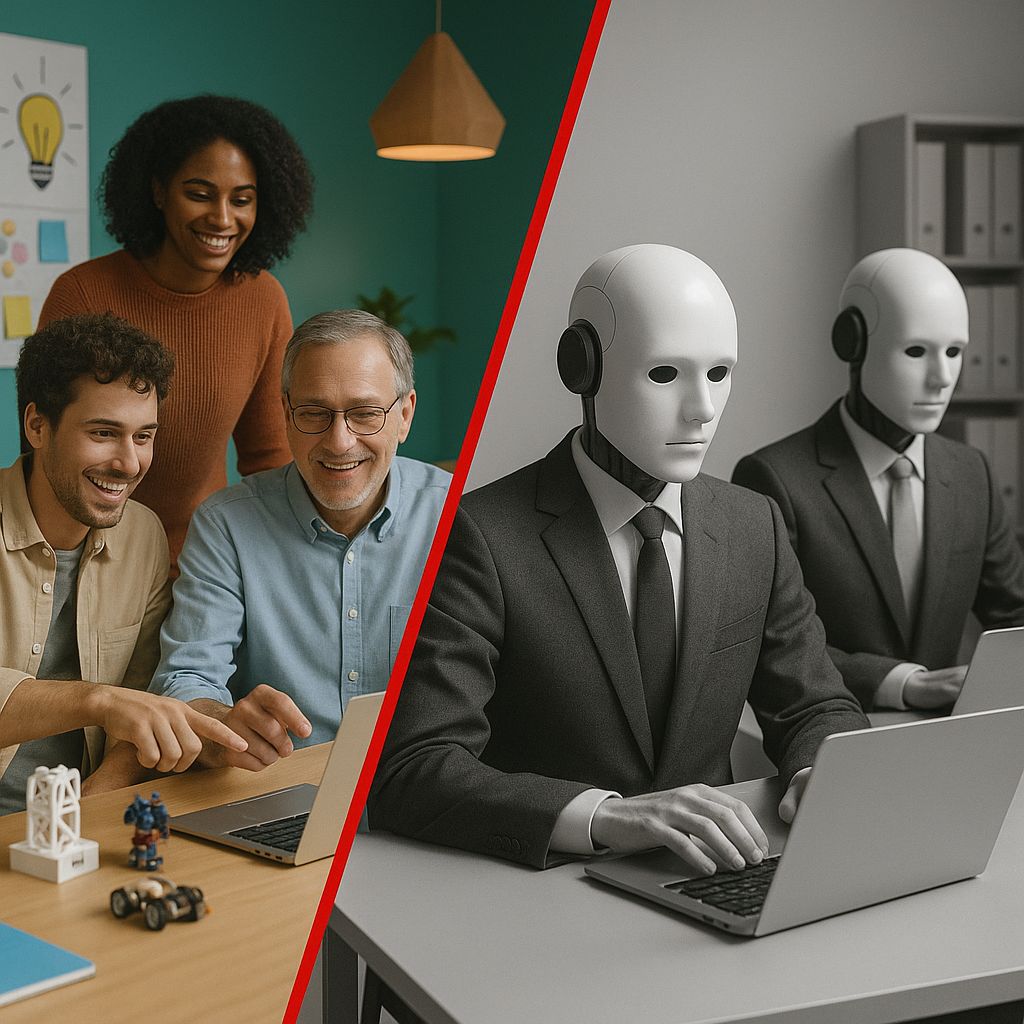
The Intern They Never Hired
His name is Lucas. He's 23, holds a master's in computer science, and has three years of university project experience. He applied to 47 companies this year. He received 43 rejections and 4 non-responses. The reason, never stated explicitly but always the same: "We've replaced this type of role with AI."
Lucas doesn't exist. Or rather, Lucas exists thousands of times over. He is the generation being sacrificed on the altar of short-term optimization. And his disappearance from the job market will trigger a chain reaction whose magnitude most executives haven't grasped.
AI won't kill innovation directly. It will kill it by ricochet. By eliminating entry-level positions, it cuts the training pipeline for future leaders, architects, and innovators. It's a pernicious, time-delayed mechanism, virtually invisible until it has produced its irreversible effects.
The Relentless Mechanics of Silent Destruction
Act 1: AI Massively Replaces Junior Tasks
The numbers leave no room for ambiguity. Hiring at Big Tech has dropped 25% in two years. Entry-level positions in the United States have shrunk by 35%. These are documented facts from the GAFAM's own HR reports.
The tasks traditionally assigned to juniors (boilerplate code, documentation, tier-1 support tickets, repetitive analysis) are exactly where AI excels. From the perspective of a CFO's Excel spreadsheet, the decision is crystal clear. From the perspective of the innovation ecosystem, it's a programmed disaster.
Act 2: The Short-Term Savings
"I replaced my intern with ChatGPT." I've heard this sentence a dozen times in six months. Always with the same pride. Always with the same ignorance of long-term consequences.
Yes, the company saves a salary. Yes, immediate productivity seems to increase. Yes, the budget is optimized. But this optimization rests on an implicit assumption that nobody questions: there will always be seniors available to steer the AI and make strategic decisions.
This assumption is false. And it's false for a fundamental reason that anyone who's managed teams understands intuitively: today's seniors are yesterday's juniors from fifteen years ago. Cut the inflow, and in a decade, the senior pool will be dry.
Act 3: The Programmed Shortage
In ten years, companies will face a critical shortage of experienced talent. Not because demand will have surged, but because supply will have been suffocated at the source. An entire generation will never have learned the competencies that only field experience confers: solving ambiguous problems, architectural intuition, the ability to see patterns in chaos.
AI optimizes the existing, but it cannot imagine the non-existing. That creativity is born from a human forged by years of failures, learning, and confrontation with reality.
Act 4: The Death of Breakthrough Innovation
The end result is a cruel paradox. The companies that invested most heavily in AI to "innovate" will be those with the least capacity for real innovation. They'll have optimized systems, automated processes, reduced costs, and nobody to imagine the next product, the next market, the next disruption.
The COBOL Paradox Is Repeating, and Nobody's Watching
Steve Yegge, former Google engineer, puts it bluntly: "The junior developer is dead. But what will companies do when their seniors retire?"
This question isn't theoretical. We've already lived through exactly this scenario. It's the COBOL paradox, and it's been playing out before our eyes for thirty years.
In the 1980s, companies stopped training COBOL developers. The language was "obsolete." Thirty years later, 43% of the world's banking systems still run on COBOL, the developers capable of maintaining them are an endangered species, and banks are trapped in systems they can neither modernize nor maintain.
The transmission break produced exactly what it always produces: a critical dependency on skills that no longer exist. And this time, the phenomenon doesn't concern a specific programming language. It concerns the entire set of human competencies that AI is incapable of reproducing: strategic judgment, breakthrough creativity, the ability to navigate ambiguity.
Gen Z Sees the Trap, and They're Reacting
49% of Gen Z members already believe AI has devalued their degrees. That number should alarm every executive who thinks beyond the next quarter.
What happens when an entire generation considers its skills worthless? They disengage. They choose other paths. They stop feeding the talent pipeline that the tech industry needs to function.
The best computer science students are already turning away from traditional software engineering, perceived as "automatable." They're heading toward finance, consulting, medicine, fields where human expertise seems less threatened. It's a silent exodus, but its consequences will be profound.
Innovation Is Born from the Creative Tension Between Experience and Audacity
Here's my conviction, and it's deliberately provocative: breakthrough innovation is born from the creative tension between the experience of seniors and the audacity of juniors. It's not one or the other. It's the friction between the two that produces breakthroughs.
The senior brings knowledge of constraints, memory of past failures, understanding of complex systems. The junior brings fresh eyes and that infuriating yet invaluable ability to ask "why do we do it that way?"
The greatest technological innovations of the past thirty years (Linux, Google, Facebook, Spotify) were born from this tension. Audacious juniors, mentored by experienced seniors.
Remove the juniors from the equation, and all that's left is optimization. Brilliant seniors iterating on the same solutions, within the same conceptual frameworks. AI will amplify their productivity, not their creativity.
A Framework to Avoid the Trap
If you're a CxO and you recognize this risk, here are four concrete actions to avoid creating your own shortage of visionaries.
1. Redefine the junior role. The junior of 2026 should no longer be a boilerplate code generator. They should be an architect in training, a problem analyst, a boundary tester. Use AI to eliminate repetitive tasks from their workload, and redirect their time toward accelerated learning of the competencies that matter: systems thinking, problem framing, communication with business stakeholders.
2. Institutionalize mentorship. Knowledge transfer between seniors and juniors cannot be an informal process left to individual goodwill. It must be a structural element of your organization, with measurable objectives, dedicated time, and explicit recognition in seniors' performance evaluations.
3. Measure your talent pipeline. How many juniors have you hired this year compared to last? What's their ramp-up rate? How many are promoted to leadership positions within the first three years? If these numbers are in freefall, you have a strategic problem, not an efficiency gain.
4. Invest in cognitive diversity. AI produces uniformity by construction: it generates the most probable response, the most frequent pattern. To counterbalance this convergence tendency, you need human brains that think differently. And the most different brains are often the youngest, the least formatted, the most "disruptive."
The Choice That Will Define the Next Decade
Transmission break equals innovation break. It's a simple equation, validated by history, and one we're reenacting at the scale of an entire industry.
The companies that understand this mechanism and act now, by reinventing the junior role, by protecting their talent pipeline, by resisting the temptation of short-term optimization, will be those that still have the capacity to innovate in ten years.
The rest will have perfectly automated processes, impeccably controlled costs, and a total inability to imagine anything other than marginal variations of what already exists. They'll be the COBOLs of the AI era: functional, frozen, and desperately searching for competencies they themselves eliminated.
The uncomfortable question that every executive should ask themselves tonight: are you creating your own shortage of visionaries?